U.S. Patent Applications

How to Choose Clear Plastic Clamshell Containers in 2026?
Choosing clear plastic clamshell containers in 2026 requires more than comparing prices and transparent finishes. The right package must protect the product, support efficient retail handling, and fit changing sustainability expectations. Material choice matters. PET and recycled PET often provide strong clarity, impact resistance, and established recycling pathways. However, local systems differ widely.
The OECD’s Global Plastics Outlook reports that only about 9% of plastic waste was successfully recycled worldwide in 2019. That figure should influence material decisions. A recyclable label means little without collection and sorting infrastructure. The Ellen MacArthur Foundation also emphasizes designing packaging for a circular economy, including simpler materials and improved recovery. Check these principles against your target market.
Look closely.
Professional guidance from the Association of Plastic Recyclers recommends designing PET packaging with compatible components, clear identification, and minimal contamination risks. For food applications, confirm migration testing, sealing performance, and temperature limits with documented supplier data. For electronics or small hardware, inspect hinge fatigue, anti-static needs, and opening force. A container that looks excellent may still crack during transport.
Smithers’ packaging market research continues to identify sustainability, lightweighting, and recycled content as major industry pressures through the decade. Yet lightweighting should not create brittle corners or failed closures. That trade-off is easy to underestimate. In practical evaluations, compare drop tests, stacking strength, product visibility, and automated filling performance using real samples.
This guide explains how to assess clear plastic clamshell containers with evidence, not assumptions. Some conclusions will remain imperfect because recycling rules, regulations, and supplier capabilities vary by region. That uncertainty deserves attention before any large purchase.
What Are Clear Plastic Clamshell Containers and How Do They Work?
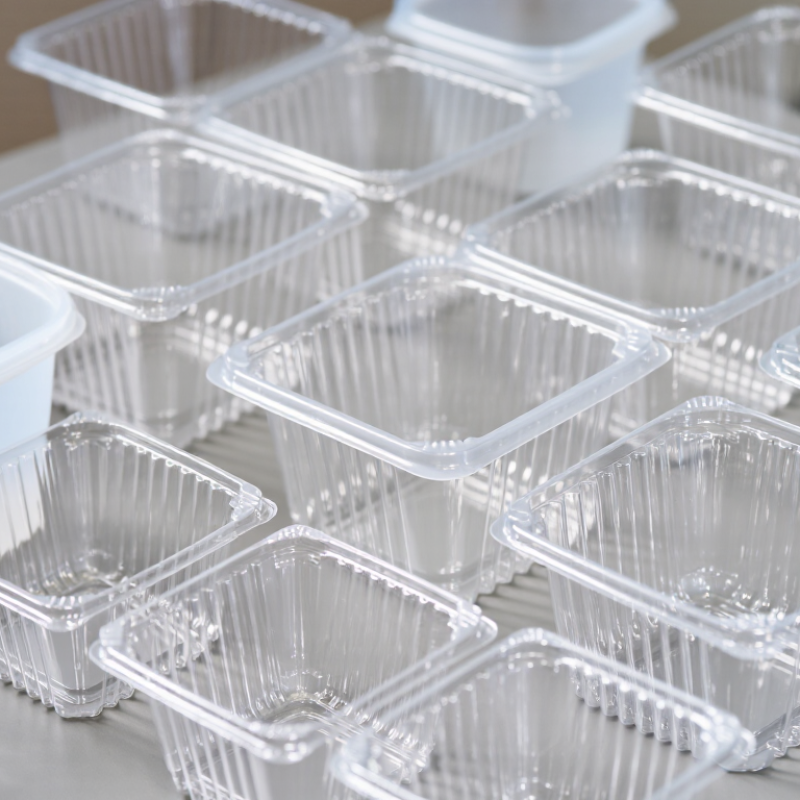
Clear plastic clamshell containers are rigid packages with two connected halves. One side holds the product, while the other forms a transparent cover. A hinge allows opening and closing. Many designs use thermoformed PET, rPET, or PVC sheets. Heat shapes the plastic around a mold. The finished shell protects small goods from dust, crushing, and handling damage. It also lets shoppers inspect the product without opening the package.
Their closure can use snap tabs, heat seals, or hanging holes. Snap tabs improve convenience, but weak tabs may open during transport. Heat seals provide stronger tamper evidence, although they make reuse difficult. Clear walls also improve visibility. That sounds simple. In practice, glare, scratches, and condensation can hide product details. I have seen attractive samples fail after repeated stacking. The package looked strong, but its hinge cracked near the first bend.
Material choice deserves careful checking in 2026. The OECD Global Plastics Outlook reports that only 9% of global plastic waste was recycled in 2019. Packaging created about 40% of plastic waste. These figures make recyclability more than a marketing phrase. A mono-material PET clamshell may simplify sorting, while mixed labels, adhesives, and coatings can complicate processing. The Association of Plastic Recyclers recommends designing packaging for recognized recycling streams. However, local facilities differ. A recyclable symbol does not guarantee actual recycling. Check the resin type, recycled content, closure strength, and regional collection rules before selecting a container.
How to Choose Clear Plastic Clamshell Containers in 2026?
What Are Clear Plastic Clamshell Containers and How Do They Work?
| Selection Factor | Common Options | Typical Characteristics | Suitable Applications | 2026 Selection Considerations |
|---|---|---|---|---|
| Container function | Two-piece hinged clamshell; sealed or reclosable designs | The lid and base are connected by a hinge. A snap, locking tab, heat seal, or adhesive label keeps the package closed. | Retail display, product protection, food packaging, and small-part organization | Select the closure according to tamper evidence, repeated access, and distribution conditions. |
| Primary material | APET/PET, RPET, PVC, or PP | PET generally offers high clarity and good stiffness; RPET contains recycled PET; PVC can provide clarity and rigidity; PP offers good chemical and fatigue resistance. | PET/RPET for visible retail goods; PP for applications needing greater flexibility or chemical resistance | Confirm the material identification code, local recycling acceptance, and any food-contact or regulatory requirements. |
| Recycled content | Virgin plastic, post-consumer recycled content, or a blend | Recycled content can reduce reliance on virgin resin, although clarity, color, consistency, and availability may vary by feedstock and processing method. | Retail packaging and procurement programs with recycled-content targets | Request the percentage of recycled content and supporting documentation instead of relying only on general sustainability claims. |
| Material thickness | Approximately 0.30–0.80 mm for many retail formats | Thinner sheets reduce material use but may provide less stiffness and impact resistance. Thicker sheets usually improve rigidity and protection. | Lightweight products may use the lower range; heavier or sharp-edged products may require a thicker structure. | Test the packed product under compression, drop, vibration, and handling conditions before finalizing thickness. |
| Clarity and visibility | High-clarity transparent sheet, lightly tinted sheet, or frosted finish | Transparent walls allow customers to inspect the product without opening the package. Surface scratches can reduce visual quality. | Consumer goods, fresh items, hardware, accessories, and display-oriented products | Check transparency, haze, gloss, scratch resistance, and visibility after forming and transportation. |
| Closure type | Snap-lock, friction fit, heat seal, adhesive seal, or hang-tab lock | Snap and friction closures support access; heat and adhesive seals provide stronger tamper evidence but are less convenient to reopen. | Reclosable packaging, theft-sensitive goods, food packs, and hanging retail displays | Evaluate opening force, seal integrity, tamper evidence, and whether the package can be opened without creating sharp edges. |
| Product fit | Loose fit, formed cavity, insert, or custom-fit tray | A formed cavity or insert limits movement and helps keep the product centered and visible. | Fragile, irregularly shaped, polished, or presentation-sensitive products | Allow practical clearance for loading while preventing excessive movement during shipping. |
| Protection level | Basic dust cover, impact-resistant design, or reinforced structure | Protection depends on polymer type, thickness, geometry, hinge design, closure strength, and internal support. | Small electronics, tools, toys, accessories, and components requiring display protection | Use distribution testing to verify performance rather than judging protection from appearance alone. |
| Food-contact suitability | Food-contact-grade PET, RPET, PP, or another approved material | Suitability depends on the exact resin, additives, manufacturing process, intended food, temperature, and applicable regulations. | Bakery items, produce, confectionery, and prepared foods when properly specified | Obtain a current declaration of compliance and verify temperature limits for chilled, ambient, or heated use. |
| Ventilation | Unvented, micro-perforated, or vented design | Vents can support airflow and reduce condensation, but they may reduce moisture protection and allow contamination if poorly designed. | Produce, baked goods, and products requiring controlled airflow | Choose ventilation only when testing shows a clear benefit for the product’s storage conditions. |
| End-of-life pathway | Accepted recyclable format, limited local acceptance, or specialized recovery | Recyclability depends on polymer type, color, labels, sleeves, adhesives, local collection, and sorting infrastructure. | Packaging programs with documented recovery requirements | Check local recycling guidance and design for easy separation of labels, inserts, magnets, and other materials. |
| Label and decoration | Paper label, direct print, sleeve, or molded detail | Decoration affects appearance, scannability, surface recyclability, and ease of material separation. | Branded retail presentation, barcodes, instructions, and regulatory information | Prefer labels and adhesives that do not interfere with identification, sorting, or container reuse where applicable. |
| Quality checks | Visual inspection, dimensional check, closure test, drop test, and transport simulation | Testing confirms fit, clarity, hinge durability, seal performance, stacking behavior, and resistance to handling damage. | All applications, especially products shipped through parcel or retail distribution networks | Approve production samples against measurable specifications rather than relying only on a prototype inspection. |
Related Posts
-

Top 10 Benefits of Using Clamshell Packaging for Your Products?
-

Top 10 Best Clamshell Packaging Solutions for Your Products?
-

2026 Best Clamshell Packaging Wholesale Solutions for You
-

How to Choose Custom Clamshell Packaging for Products?
-

How to Find Reliable Clamshell Packaging Wholesale Suppliers?
-

How to Choose the Best Small Clamshell Containers for Your Needs